



Ask a Saxophone Repairman: Relaquering, Finding a Repair Person, Neck Cork, and More
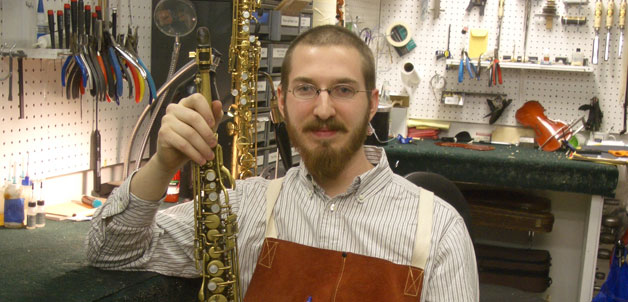 This post is part of a special column titled “Ask a Saxophone Repairman” with answers supplied by our resident repair whiz, Matt Stohrer of Stohrer Music.
Disclaimer: Saxophone repair is a complicated business, depending not only on the skill of the repairer but on the reality of the situation at hand. The advice given here is given without your horn in my hands, so take everything I say with a grain of salt, and take it upon yourself to get more opinions and form your own conclusions. This column is not a substitute for finding a great saxophone repairman and building a relationship- instead it should be viewed as a resource to be used so that you can know more about your horn and become a smarter consumer and a better saxophonist.
The new JodyJazz DV HR Tenor uses the patented DV secondary window to add mid and low harmonics, resulting in a more authoritative tone than normal tenor sax mouthpieces provide. And the long straight somewhat high baffle gives the mouthpiece it’s fantastic projection and cutting power along with excellent altissimo.

JODYJAZZ.COM
The New DV HR Tenor from JodyJazz

Hey everyone! Its been a little while since I wrote on here, but I’ve been busy moving to a new house and welcoming our first child into the world. Now I’ve got my head screwed on (mostly) straight again and back here on Best. Saxophone. Website. Ever. Keep your questions coming!
Hello,
My name is Ashley and I play alto saxophone in my high school marching and concert band. My horn needs to be re-lacquered and i have no idea where to get that done. I live in North Alabama and if you could recommend a business or repairman i can contact that might do that i’d really appreciate it. Thanks!
Ashley,
Do not relacquer your horn. It is an abrasive process and causes more problems than it fixes (which is none other than appearance).
(Quick breakdown of why relacquering is bad- see below for help on finding a saxophone repairman in your area)
Relacquering involves buffing, and buffing is an abrasive process. During buffing, metal is removed from bearing surfaces- the ends of hinge tubes, posts, toneholes… and you end up with slop in your mechanism and unlevel toneholes. And it’s not like they purposefully try to buff these places – look at this video of how it is done! It is an extremely imprecise abrasive operation on a precision instrument. Clearly the skill of the individual doing the work can make it less bad and refitting the keys and leveling the toneholes can fix much of the damage. If the relacquering is done by a chemical strip and then hand-polished, that will make matters better as well.
But in reality, the way most relacquers were done (because not many people do it anymore – it used to be a matter of course during overhauls back in the day) was fast and furious, usually by the lowest man on the totem pole in the shop because the job itself is dirty, dangerous, and all-around sucks to do. Now not many folks do it, and even less folks do it well.
(back to how to find a repairman)
I do not have a specific recommendation, but here is a saxophone forum where you can find them – this particular link is the “evaluations” subforum. It is helpful to do a search inside this subforum for your area and see if anyone else is talking about it. Note that this is a public forum, so make sure you take everything said there with a grain of salt (you’ll notice a lot of the content is guys yelling at each other about stuff they don’t know much about, but there is also some really great info and advice there if you dig through.. kind of like real life). Also there is a dealer directory by state on the same forum here.
Another good way to find a good repairman in your area is call the local college saxophone instructors and ask where they go for repairs. If there is a consensus, then its a good bet.
Good evening Matt,
I have 2 quick questions if you don’t mind please…
The first, is there an easy repair for an Otto Link ligature? The facing that rests against the reed has come loose on my soprano mouthpiece.
Secondly, do you know anything about tenor saxes designed or created by Dick Rumore? Our bassist works in a local music store and wants me to check one out they have for sale but I personally haven’t heard about the line of horns and all I could find was that they’re based in Tampa obviously from the bari saxophonist Rumore. I’ve tried looking for some sort of reviews to no avail. I’d like to get some idea of the quality of horn it is in terms of intermediate or professional level as well as durability in the long haul especially where having repairs and all are concerned, and lastly the look of the horn being pleasing to the eye.
I presently play a Beuscher 400 US made from the 60’s and would love to upgrade to a more professional horn at some point reasonably priced. However, I’m not at the point of getting a Keilwerth yet…lol! But if I can get a good quality horn for the money, even if it’s a good used one, it would be nice. Just curious on the specs about this one before even taking the time to play it and see how it feels and sounds.
Thanks for your time and consideration of these two questions are greatly appreciated. I just found this site tonight looking for reviews about the Rumore tenor horn.
No quick fix! You can take it to a repairman and they might be able to work with it, but its most likely going to involve soldering and/or metalworking a bit.
As far as the Rumore horn, I have not heard of it before. But unless its a vintage stencil instrument, it is going to be a new East Asian import (the kind I wrote about here) and will not be what I would consider a professional sax. In fact, your 400 is a great horn – up until 1960-ish, they are professional horns. Even the later ones are very nice and you would need to either buy a vintage pro horn or a brand new top-end horn to beat it. And really you might not ever need to if you just base your opinion on the sound rather than what the 2nd chair sax player says (you are first chair… right?? :-)).
Check out this list here to figure out which kind you have. All of them are great horns when in good shape (Have you considered a pro overhaul? It can make a big difference!), and even the later ones are really great horns though they don’t get much respect. I made a video about a 1959 Buescher 400 a little while ago, watch it here. Good luck and if you are still puzzled, send me some photos and I can help you out.
Hi Matt,
I’m Austin, a high school student. I recently stumbled upon your website (which is very nice, by the way), and your repairman page.
So if you could spare a little time to give me a little advice, I would really appreciate it.
The cork on my Alto Sax neck is peeling off, where the mouthpiece goes. The bottom side of the cork tube has patches where the cork is completely gone and is showing the metal. Currently, I am using folded paper to cover up the empty patches, but I noticed that my playing quality has decreased because of it.
Is it at all possible to repair the cork or replace it? If not, how much would a whole low to medium quality Alto Sax neck cost roughly?
Thanks in advance,
Austin
Austin, yes this is a totally normal repair and super easy. Its called replacing your neck cork. It usually costs $15-$25 to get it done, and usually while you wait, about 20 minutes or so, most of which is watching contact cement dry. If you are feeling adventurous and would like to learn to do a common repair that will come up again and again in your saxophonic life, google “how to replace saxophone neck cork”- there are dozens of pages and even a few videos. Watch/read a few of them to find one that makes sense to you- not all of them are equal in value.



October 9, 2012 @ 3:55 pm
Not sure what to do – my son played alto sax in elementary/junior high. He hasn’t played in over six years now. My nephew is now starting lessons and I want to give him my sons sax to use but the local music store tells me it needs new cork (mites?) and other work done which will be over $400. How do I determine the value of investing this much? If its going to be worth it, I’ll do it and eventually resell.
October 9, 2012 @ 7:29 pm
If you would like to email me some high-resolution photos (my contact info can be found at my website above) I can tell you whether the horn would be worth it to get into good shape, or whether your money would be better spent getting a replacement.
October 27, 2012 @ 1:50 pm
Dear
i have a problem in my B ( first finger ) its low tuning specially on the first octave
wish you help me
cheers
November 2, 2012 @ 6:35 am
Without a very detailed description, its hard to say. I would take it to a repairman and have them take a look at it.
I will give it two guesses just for the heck of it:
1. your bis spring is off or weak and the bis is hanging low
2. the B is not closing the key above it (sometimes called the C# or the bar key) but when you add A it closes fully
November 1, 2012 @ 11:56 am
i cant play lower octaves on any key especially the last three notes
November 2, 2012 @ 6:35 am
You’ve got a leak or something. Take it to a repairman to get it sorted out.
December 2, 2012 @ 2:12 pm
Hello Matt!
I am a middle school beginning alto saxophone player. Something is wrong with my saxophone. I can’t play my high or low D’s! Same thing with my E’s. There is something wrong with 5th key. I don’t know what it is, but do you think you know? Can you please give me some advice?
Please reply back.
December 3, 2012 @ 5:43 pm
Definitely sounds like you’ve got a leak. Take it to a repairman and they’ll have you sorted in no time.
December 30, 2012 @ 1:14 pm
I have an alto Saxophone that needs new corking. Is that something I would have to have a repairman fix, or is there a way I could buy cork on-line and fix it myself? Thanks in advance for your response.
April 7, 2015 @ 1:46 pm
Many years ago I bought a sheet of cork and did my own. Recently a friend bought a ‘block’ of cork, put it on then filed and shaped it to fit (seems like hard work). Couple of weeks ago I and my tutor had our corks replaced by a repairer while we waited for £10 each – best option.
And don’t forget to take your mouthpiece with you so he can judge the thickness.
PS: I mark the position with a biro for a quick set up with the section.
Wondered why my sax was playing sharper and sharper – the cork was worn and sliding up the crook as I pushed the m/piece on!!! LoL.
June 30, 2013 @ 6:05 pm
My saxophone will not play high d and I don’t know why the
Fingering is correct it just goes really high and will not play that note
July 1, 2013 @ 4:23 pm
Hello, I am looking into replacing the neck cork by myself but I was wondering if I need specific saxophone exclusive cork or would any regular retail store cork be fine? Thanks for any help in advance :D
September 19, 2013 @ 5:44 am
how much would it cost me to fix the crck of a mouth peace and a key of an alto saxophone?
September 19, 2013 @ 7:02 am
you can buy a new mouth piece on ebay for less than 10 dollars; that includes shipping, taxes, and the cost of the piece itself. I too had to buy a new mouth piece.
unfortunately, i don’t know what to tell you about the key, you will have to wait for Matt Stohrer to answer that question.
November 17, 2013 @ 3:00 am
I just purchased a Holton 234 with the serial number 310110, it is in perfect condition with the exception of the tarnish and loss of plating. the instrument is all there and my neighbors son plays the sax, he said it sounds excellent and is a great alto sax and be be worth having re polished and plated. what is your thought on this. if you agree where would I get it done I am in south Florida, thank you for any help you can provide
January 26, 2017 @ 1:20 pm
Hi Joe. Never have a saxophone relaquered ( replated) it ruins the sound and value and even if you can locate someone still willing to do it it will cost an arm and leg. Saxes look cool with a mixed used patina . Never relaquer !!!
????????
March 24, 2015 @ 9:16 am
Hello, I play the Alto Saxophone in middle school and I in 7th grade. I have a problem with my B not it does not sound like a normal B. I tuned my sax and it perfectly in tune. I checked if there were any springs on the top part of sax and I don’t know if one is misplaced and I don’t see it or it is just fine. To me it looked fine but I don’t know. It was fine on moment then I put my saxophone down left then came back played it and it was something wrong with it. Can you please suggest what I should do?
Thank you,
Ana
August 28, 2015 @ 4:06 am
I just re-corked the neck on my Martin Tenor made in the 60’s. I’m still having trouble on the low C and below. My question< The cork that I used is the correct thickness, but seems rough and porous. I have other cork for my clarinet tenons , and it is nice and smooth but not wide enough for the tenor sax neck. Do you think that some new smooth cork , wide enough for the sax, would be an improvement. Thanks, Jack
January 6, 2016 @ 7:26 pm
I just got a saxophone from eBay. A Vito Alto Saxophone by Yamaha. The neck piece was NOT as described and is in poor condition. How much would it cost, do you think, to replace the cork on it?
Also, one of the keys is warped and should be nice and pearly looking, smooth to the touch. Is there a way to smooth that out? Cost?
Thirdly and lastly, a couple of the little pads are missing as well as one key does not go down all the way when I play an F. How much would it cost to fix those things?
Thank you!
March 30, 2016 @ 2:40 am
Hello! Please help me with my problem at mark vi alto! I buyed with all the pads new very well work except C# low, that sound is very quiet and one friend of mine told me that is a problem of manufacturing, and to resolve is need to put something inside near c# to resolve this! What you can tell me? Thanks a lot, Claudio!
June 3, 2016 @ 11:05 am
Hi, I recently became acquainted with a Buescher True Tone alto sax that i believe needs new pads and springs plus thorough cleaning it is also loosing its paint and lacquer, but if that’s no harm its fine any suggestions on who i can turn to for this job and maybe how much the price could be ? I’m From West Texas. Thank You.
September 30, 2016 @ 12:50 pm
I have an old Elkhart Alto Saxophone from my great aunt that she used to play in high scool and I am looking to get it completely cleaned out with new everything, or as much as I can salvage. If anyone could reccomend me any business that specializes in things like this that would be great.
October 12, 2016 @ 8:45 am
I’ve been playing Alto Sax in my high school’s band for a few weeks now. The one I’m using sounded fine until I cleaned it, and now it squeaks every other note I produce. I didn’t tighten any screws, or did anything wierd, I just cleaned it because it needed to be. I also recently started using Rico reeds at 2 Strength
January 26, 2017 @ 1:28 pm
Hi Jade ,
How did you clean it ? A sax should be swabbed out EVERY time after you finish playing so moisture doesn’t ruin your pads .
I worked at a music store for many years and people would come in all the time that had put a woodwind instrument into the bath tub because it had gotten a bit smelly. That ruined All the pads and a complete pad replacement was usually necessary . Hopefully you didn’t give you sax a bath ????
November 2, 2016 @ 7:52 am
Hello I had a question! I got a tenor sax from a friend and it hasn’t been layed in over five years so it is not letting me play most the high notes with the octave key and I struggle to play low notes like C and B. Any tips?
November 13, 2016 @ 5:00 pm
My saxophone’s key above my first lower key isn’t closeinv right.
How do I fix that.????????
November 21, 2016 @ 11:04 am
How much would it cost to bend back the neck hole on the sax itself not the neck
December 14, 2016 @ 6:35 am
Hi Matt My octave does not work when I press my left ring finger ?Got any suggestions ?It seems to me it envoles the upper parts.Thanks,and belated Congradulations .
January 23, 2017 @ 4:34 pm
pls what kind of paint is used to spray a saxophone???
January 26, 2017 @ 1:31 pm
Not anything you can do yourself so Pleeeeease don’t spray paint your sax !!!!!
January 31, 2017 @ 4:20 pm
thanks Trevor………… I don’t wanna spray it myself, I just wanna have an inkling on the kind of paint used in spraying ití ½í¸£í ½í¸£í ½í¸£
April 4, 2018 @ 6:52 pm
so i have an issue! on my tenor, the secondary octave mechanism (the one that opens for d4-g4) is very close to the #f5 mechanism bar right above it and the pad’s come unglued and sticks to the tone hole, making it impossible to play these notes without overtones. is there any way to fix this issue without taking off mechanisms and bars, or is this something i should just leave to a professional?
August 2, 2018 @ 10:48 pm
Acid bleed… cosmetic flaw or something to worry about?