



Ask a Saxophone Repairman: Sticky Keys, Mouthpiece Refacing, and More
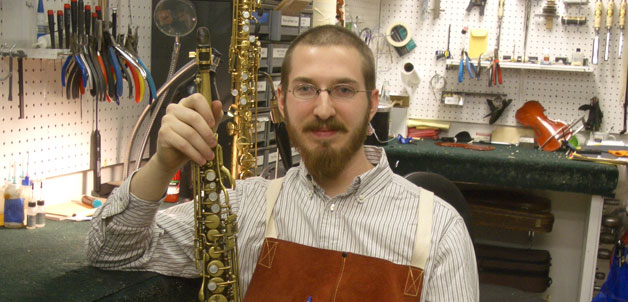 This post is part of a special column titled “Ask a Saxophone Repairman” with answers supplied by our resident repair whiz, Matt Stohrer of Stohrer Music.
Disclaimer: Saxophone repair is a complicated business, depending not only on the skill of the repairer but on the reality of the situation at hand. The advice given here is given without your horn in my hands, so take everything I say with a grain of salt, and take it upon yourself to get more opinions and form your own conclusions. This column is not a substitute for finding a great saxophone repairman and building a relationship- instead it should be viewed as a resource to be used so that you can know more about your horn and become a smarter consumer and a better saxophonist.


Hello,
I’m retired and started playing tenor sax 4 yrs ago. My problem is biting down and having to blow hard when I play. My question is my mouthpiece – I have a Selmer C* and Otto Link 5* stm. Should I look to have them refaced, or look for a new mouthpiece? I play a Keilwerth SX90. I have major problems on low C and B flat. Checked for leaks, no problems. I love to produce a dark sound (Ben Webster) with a easy blowing mouthpiece. Any help woould be greatly appreciated. I thank you in advance for your time.
Regards, Dominic
Dominic,
I would have your horn checked for leaks, which is the most likely culprit.
Not all leaks are easy to see! If you’ve been doing it yourself with a cheap leak light, I’d take it to a tech. If you have already taken it to a tech, I’d get a second opinion just to be sure. Other than that, check out the mouthpiece articles on this website, and also this mouthpiece article I put up on my site a little while ago, there is information there that might help you: How To Choose A Saxophone Mouthpiece.
Hi Matt,
I have a troublesome problem with a sticky G# key that just won’t go away; I trust my usual tech implicitly as he has more experience fixing important horns than I have walking on this planet, but he’s stumped too, although he’s now found another horn that replicates the problem and is down in his lab as we speak.
This is a brand new horn, or at least a never-played horn, a 2002 Jupiter XO artist series alto, and it is only the G# that does this, although you can hear the palm keys kiss as they release. I have three other horns and none of them show any signs of this, so I doubt it is my saliva. We tried ultra-cleaning the rims, I tried powder paper, we tried using loose-leaf paper to gently sand over the edges, finally we replaced the pad with a brand new leather pad and the problem is less now, but it is still there. It’s like there’s a suction beyond the force of the spring holding the pad down; it goes ‘smack’ when it releases.
What could be going on here? Could it be the laquer that Jupiter used? We thought perhaps because the horn had sat unsold for so long (could be Canadians are wary of Chinese-made horns, but the horn is otherwise very nice, many players tell me they agree; it sat in a small town music store for 8 years before I bought it) — if I remember to ‘pop’ the valve before playing, everything is fine, but it is driving me crazy. Is there anything I can try?
-Gary
Hello Gary,
Jupiter is actually a Taiwanese horn. But anyways, it could be the lacquer I suppose, but if you sanded the edges that lacquer should be gone. So it sounds like you’ve tried most everything! Make sure to double check the mechanism is functioning correctly – does the pad stick or act sluggish directly after changing it, or does it take a while to get sticky again? If it is sticky right from the get-go, either the pads are bad or there is a mechanical problem. Assuming there is no mechanical problem, try cleaning the tonehole with naptha and replacing the pad again. If the toneholes are clean and the pads are good quality, you shouldn’t have sticking problems – and if you do, powder paper should work! Maybe try leveling the tonehole (this will certainly remove the lacquer if it hasn’t been removed already) and replace the pad again.
I have an older model brass Otto Link 5* tenor mouthpiece. The 5* appears on the body of the mouthpiece as opposed to the newer links which have the facing # on the shank. I like using the 2 or 2 1/2 strength reeds, but because my embouchure is fairly well developed, the mouthpiece closes up on me when I play loudly. Is it possible to have my 5* refaced and opened up to perhaps a 7* so that I could continue using the softer reeds, and is this something that you would be able or willing to do for me Matt? Thanks for your help!
– Harold
Absolutely! I mess around with refacing sometimes, but I am not the best by a long shot and just regular old saxophone repair has kept me busy lately. These are the guys I send my mouthpiece work to: http://www.mouthpieceguys.com.
There are a lot of refacers out there – same as saxophone repairmen, some are alright, some are good, and a few are really, really good.
By the way, that Otto Link you’ve got is a nice vintage mouthpiece. Take good care of it!
What kind of repair should we a working saxophonist learn ourselves? I have never done any work to my horn, and it’s the most valuable thing I own. Are there things that I could do on my own that would help keep my horn in better health?
The more you know about repair, the better saxophonist you will be. Understanding why and how a thing works will make it easier to use. As far as what work you want to actually do yourself, that is a different matter and only you can know that.
I highly recommend reading this book: The Complete Woodwind Repair Manual, by Reg Thorpe. I actually thought I would one day write a repair book until this one came out (unfortunately it was not written yet when I started, and the books available at the time were really outdated), but Reg has done a spectacular job. Just reading it will make you a better player and consumer and judge of repairs.
You can purchase that book here: http://web.memberclicks.com/mc/quickForm/viewForm.do?orgId=napbirt&formId=36938 %5BSorry(!), but this web page has disappeared since the original publication of this article]



June 4, 2012 @ 10:50 am
Regarding the sticky pad issue: Your repairman should just replace the sticky G# pad with a Kangaroo leather pad. These won’t stick like the leather waterproofed pads they have now, which all stick. It’s always more prevelant on the G# and C# since those keys remain closed and rely on spring action to release them. I’ve had my repair guy do this on my horns and it solved the pesky problem right away.
June 4, 2012 @ 7:29 pm
I’d have to disagree with the statement that all brown leather pads stick, but the kangaroo leather pads (one type can be found here: musicmedic.com) are indeed another option that I was remiss not to mention.
June 4, 2012 @ 11:24 pm
Cool Matt. Ya, I’m just going what my repair man in Chicago (a well known pro) has told me regarding the leather pads – that they pretty much all have this water proof coating on them now that can make them sticky and there’s no getting around it. (Let me know if you know different?) Maybe that’s changed – don’t know. I have a Yamaha 62R Soprano I bought new in 1987 that still has original factory pads that NEVER stick. Had a 2 Selmers – and alto and tenor – that never had sticky pads up until I had them re-padded with leather pads in the early 90s and since then, they stick like crazy. (And they were both re-padded by different guys.) I get by using the powder paper with them but next time going to try something different pad wise I think.
April 2, 2018 @ 4:10 am
Hi!
Calling from Sweden.
The sticky G# is a usual problem. Over here i´ve red on the internet that it depends on the holes chimney – not the pad.
Since then I Always after playing put any paper between, move it. If it looks wet I put in a dry one.
More over – the holes´metal korrossion can be the problem.
I use a 2000 wet grinding paper in that case.
The Eb hole can be stucked if You don´t place a paper there after playing and put the sax in the case.
Everything must be as dry as possible after playing.
I also care for the octave keys and the Lowe C# key.
The Jupiter soprano is the worst one among my horns
Even the clarinet gets this care.
My horns: 1953 Selmer alto, old Conn tenor, rather new soprano and an old very good Buffet clarinet.
Close to me i visit often an hungarien educati
ed repairman.
For me isn´t pads the problem.
I´ve played my horns since a I was 14 beeing 80 just now.
Marching Bands, jazz combos and Big Bands.
Practise every day – rehearsing tomorrow with one of my three bands, New Orleans, jazz combo and the Big Band –
10 gigs are waiting before midsummer.
1
June 6, 2012 @ 6:04 pm
I’ve found the Saxgourmet never-stick pad powder a good solution to that same problem, with one caveat. It’s kind of messy. Before, I was frequently swabbing the pad and tonehole with lighter fluid. I believe I’ve done one re-application of the powder since December. The stuff has a patchouli smell and a R. Crumb hippiechick on the label.
June 7, 2012 @ 3:19 pm
Re; sticking pad problem. All these responses are possibilities but one thing I have been running across lately(besides being a player, I am also a fairly experienced Tech) is unfinished tone hole chimneys.
When the tone hole is milled or cut at the factory, the cutting tool leaves a fine burr on the edge that contacts the pad. If this burr is not dressed(removed) it will create the symptoms of a dirty/sticky pad. When the horn is lacquered it softens this effect slightly but after a few months of playing the lacquer breaks down a little and the burr becomes more prominent again.
The only solution I have found is to disassemble the horn to where you can access the tone hole, and very carefully go over the edge of the tone hole with 400 or 600 grit wet/dry sandpaper till the edge is smooth. This has worked for me when all other procedures/treatments have failed.
This is not a just a problem with the glut of Chinese and Taiwanese built horns on the market today. I have seen the problem with brand new, expensive, top line Selmers.
Hope this helps someone.
April 1, 2018 @ 8:26 pm
Hello Dennis, thank you for this information. I am reading this now in 2018, but see it was written in 2012. I hope all is well and you are playing the same, smooth tenor as always. If you still do tenor repair work, what city are you in? As another reader has stated, taking your horn to different places, to find that one that was just adjusted has leaks or needs repair can be disappointing. About finding issues on brand-new, good horns, like a Selmer, if you are not a top player, how can you be certain the horn you buy is the best of the ones there? Do the shops not check each one?
Thank you again. mike
July 18, 2012 @ 4:51 pm
Can you possibly recommend a reputable saxophone repair man in close driving distance from Indian Harbour Beach, Florida? I have a “Blessing” Tenor Sax from Elkhart, Indiana which is in need of TLC.I would appreciate any help you could give me. Thanks–Craig.
July 18, 2012 @ 4:53 pm
I don’t know anyone personally, but call around to local colleges and see who the saxophone professors/teachers recommend.
January 16, 2013 @ 8:48 pm
I have a YTS-52; which I’ve had since 1988. I was wondering if getting this saxophone unlacquered would change the sound of it? I love the sound and feel of my trusted “friend”; on the other hand I also like the look of the unlacquered saxophones that are out on the market.
July 7, 2013 @ 11:09 am
I HAVE A PROBLEM ON MY MARK 6 NUMBER 183 *** PROBLEM low note С# ..C H B …SAX SHUT adjusted at the bottom notes are taken BAD plays
When the game is like gurgling, OR THAT IT WILL NOT CLOSE….Sax was being renovated master does not know what to do..
— I LIVE HERE IN MOLDOVA AND NONE OF THIS WHO UNDERSTANDS .this decision may?http://www.youtube.com/watch?feature=player_embedded&v=q7efNh7qJlc IS THERE SUCH WAY TO SOLVE THIS PROBLEM.? CAN YOU KNOW HOW TO HELP ME I JUST I am suffering when the game and would be grateful to
March 21, 2018 @ 11:11 pm
My new meyer 5m hard rubber alto mouthpiece is cut slightly off center. The right side of the tip is a bit higher than the left and it plays seemingly fine. I was wondering if you have had any expierience with this problem?