



8 Tips for an Open Throat and Bigger Sound
UPDATE: Since writing this article, my views on the topic of an “open throat” have actually changed quite drastically. So forget about this silly article and hop over here to get the real skinny on this super-important concept.


With any wind instrument, the rule is more air you have access to, the more “fuel” you have to create a big sound that hits listeners right where it hurts so good. (That might have sounded a little creepy, but I think you get the point.)
In recording technology, we have what’s known as a “signal chain” in which engineers strive to push the maximum amount of non-distorted sound through the chain of cables, outboard gear (effects boxes, compressors, mixers, etc) and finally into the digital or analog recording device such as a computer or analog tape recorder.
In our sax playing, it’s the same principle. The the sound starts that the diaphragm, continues up the throat, passes through the inner mouth, then the reed, mouthpiece, and finally the horn itself. The throat is a crucial part of the chain of air, and the more we can open this conduit, the better we’re going to sound.
I was recently poking around the wonderful and ever-popular forum at SaxOnTheWeb.com as well as a few other sites and came across some great tips on the topic of keeping an open throat.
The List
1. Just Relax
It’s sometimes amazing to see how much tension is unconsciously happening throughout the body when we’re playing, especially in parts of the body that we’re not yet used to being aware of. Thinking in terms of being as relaxed as possible while still providing proper pressure from the diaphragm and embouchure will automatically work wonders.
2. Practice singing the “AHH” or “HAR” sound while you’re playing.
These vowel sounds naturally open up your throat. The opposite would be to pronounce the “EEEEEE” sound which closes the throat.
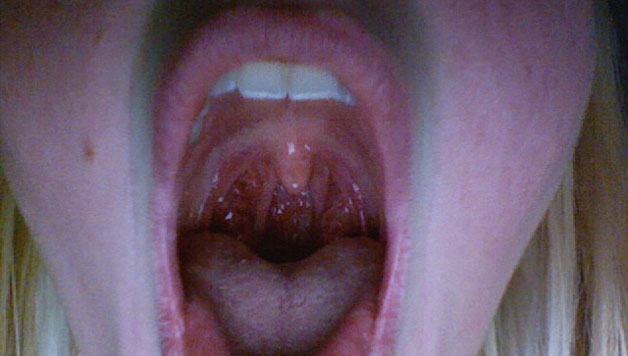
3. Raise the soft palate.
For those of you unfamiliar with the soft palate, WikiPedia defines it as “the soft tissue constituting the back of the roof of the mouth. The soft palate is distinguished from the hard palate at the front of the mouth in that it does not contain bone.” As awkward as it may seem, doing whatever you can to raise this part of your inner mouth will indeed open up your throat.
4. Learn to growl.
Growling on the saxophone is simply creating that raucous sound heard in rock and roll saxophone. This effect involves singing through the horn, and chances are that growling will force you to sing one of the “AAAAH” sounds mentioned in step two. If you’re new to growling, here’s a quick video to get you started.
5. Blow warm air.
Make sure that the air you’re blowing through the horn is sufficient to fog up a pair of eye glasses. One quick way to get a sense of the difference that this makes is to put one hand in front of your mouth, and the other on your neck over the throat area. Blow cold air into your hand, and notice what the throat feels like. Then practice blowing warm air into the hand, as see how that feels. Pretty big difference, right?
6. Learn what it feels like to play with a closed throat.
When we cough or gag, the throat is almost completely closed off. Make sure that the feeling in your throat while playing is diametrically opposed to the feeling of coughing or gagging.
7. Say “HOP” as you inhale.
This will prepare your throat to be open, and as long as you follow up that open inhale with warm air, then you’re golden!
8. Imagine blowing downwards.
Pointing the air in a downwards direction will force you to open the throat as you strive to make that additional space in the throat for the air to move towards the floor.



March 21, 2011 @ 7:18 am
I was taught the biggest open throat is to stifle a yawn. Just another way of thinking of it.
March 21, 2011 @ 9:00 pm
Hey Dave!
Yes, I’ve heard that as well, but I’ve also heard some interesting objections to it, as yawning can often involve a certain amount of tension, which I agree with. However, it’s really all about experimenting and seeing what works best, as everyone’s physiology is different.
Thanks for popping in,
Doron
Standing Straight and Sounding Great | Best. Saxophone. Website. Ever.
April 4, 2011 @ 6:08 am
[…] the habit of good, proper posture pays – and pays handsomely. As I mentioned in my article, 8 Tips for an Open Throat and Bigger Sound, the path between the diaphragm and the bell of the horn must be as unencumbered as possible. And […]
- Standing Straight and Sounding Great
April 4, 2011 @ 4:46 pm
[…] the habit of good, proper posture pays – and pays handsomely. As I mentioned in my article, 8 Tips for an Open Throat and Bigger Sound, the path between the diaphragm and the bell of the horn must be as unencumbered as possible. And […]
April 5, 2011 @ 12:30 pm
Hi! I’m doing my last year of the graduate on sax. Unfortunately my sax teacher had a big operation. So they found a substitute teacher. He said that my technique is so weak, my breathing way is wrong, my articulation is dirty… I’m agree that for so long time I can’t stop moving my throat when I do the staccato. Then I’m trying to understand if my throat is closed. I feel the end of my saxophone’s life after having been playing 10 years… Do you have some suggestion?
April 5, 2011 @ 10:24 pm
Hello Emenem,
First of all, I would certainly not see your new teacher’s comments as being a reason to see this as the end of your saxophone playing career. A good teacher will often have a lot of suggestions. N matter what, you will never regret putting in the hard work to make the suggested improvements.
As far as telling if your throat is closed, I wouldn’t worry so much about whether it was closed or not, but instead follow the steps listed in this article to make sure it’s actually *open.* My favorite tip is to blow warm air through the horn #5. If you can do that while playing, then it will be very more or less impossible that you’ll be playing with a closed throat.
Just keep at it no matter how challenging your teacher is, since most things we do end up being harder than we imagine, and nobody who’s great on their instrument got that way without working hard even when they wanted to give up. And if after a while you find that your teacher isn’t inspiring you but only tearing you down, I’d look for a new teacher to study with outside of school.
I hope all of this helps, and thanks so much for your excellent question.
All the best,
Doron
July 17, 2011 @ 4:07 am
This was so helpful! I play French Horn and have been struggling with a closed throat, and this is the first thing I’ve found that has been informative. Thank-you!
July 17, 2011 @ 1:37 pm
Hello Emma,
Wow, a french horn player – awesome! It looks like the site is getting more and more non-sax player, which is awesome. So glad that the article helped as you found some general wind-playing principles that apply to your instrument as well.
Hope you keep stopping by the site, thanks!
Doron
Debunking the Biggest Myth About Playing with an “Open Throat” | About Tenor, Alto, Soprano And Bariton Mouthpieces For Saxophone Kit
November 29, 2011 @ 8:00 am
[…] few months back, I put out an article titled 8 Tips for an Open Throat and Bigger Sound. A short while later, while corresponding with killer New York saxophone player Adam Kolker […]
Debunking the Biggest Myth About Playing with an “Open Throat” :- Soprano – Saxophone.
May 23, 2012 @ 6:37 am
[…] few months back, I put out an article titled 8 Tips for an Open Throat and Bigger Sound. A short while later, while corresponding with killer New York saxophone player Adam Kolker […]
December 27, 2012 @ 10:20 am
My throat hurts badly when I play and sometimes, I regret buying that instrument that gives me so much pain
October 10, 2016 @ 1:36 pm
I am trying to play my altissimo g I currently use a number 3 Alexander especial tenor would a 3-1/2 work better
February 7, 2017 @ 8:04 pm
suggest food habits tht affect throat or that open up throat…iam a worship leader and while singing i cant take up high pitch and my sound is going while singing..
April 3, 2024 @ 7:44 am
George Garzione at Berklee taught me to say “Hawwww” when exhaling and told me to get my lower lip out more since I was playing with a classical embouchure that was restricting my sound. It was a total game changer for me and my sound got huge.
April 6, 2024 @ 8:13 am
That’s interesting, as Liebman proposes an “EEE” sound since he says the “AHH” requires the tongue to be raised and also moves the tongue farther from the reed. But I’ve also heard that it’s good to move between multiple sounds. At any rate, as mentioned at the top of this article, the information here is no longer reflective of my current understanding (I should maybe just take this down altogether), so feel free to head over to the follow-up “correction article” at https://bestsaxophonewebsiteever8b1b372fee-xtdnj.wpcomstaging.com//debunking-the-biggest-myth-about-playing-with-an-open-throat/) :)